The world of OMICS is moving fast, and staying ahead of these breakthroughs is essential for researchers, biotech innovators, and healthcare leaders alike. At CPGR, we’re constantly tracking the latest OMICS research trends so we can support scientists with the most advanced tools, platforms, and workflows.
Here are the most exciting developments redefining modern biology and how CPGR is positioned to help drive them forward.
1. Single-Cell Proteomics Is Entering a New Era
A major leap in the OMICS landscape is the rapid progress in single-cell proteomics (SCP). Scientists can now analyze thousands of proteins in individual cells, giving deeper insights into:
- Cellular diversity
- Disease progression
- Immune responses
- Treatment resistance
This shift is powered by next-generation mass spectrometry and ultra-sensitive, low-input workflows that were impossible just a few years ago.
Why It Matters
Single-cell proteomics allows researchers to understand why two cells in the same tissue can behave completely differently, which is vital for cancer research, immunology, developmental biology, and precision medicine.
CPGR’s Role
At CPGR, we support these breakthroughs through:
- High-resolution mass spectrometry
- Custom proteomics workflows
- Tailored single-cell analysis support
We’re helping researchers push the boundaries of what is possible in protein-level discovery.
2. AI-Powered Data Pipelines Are Transforming OMICS
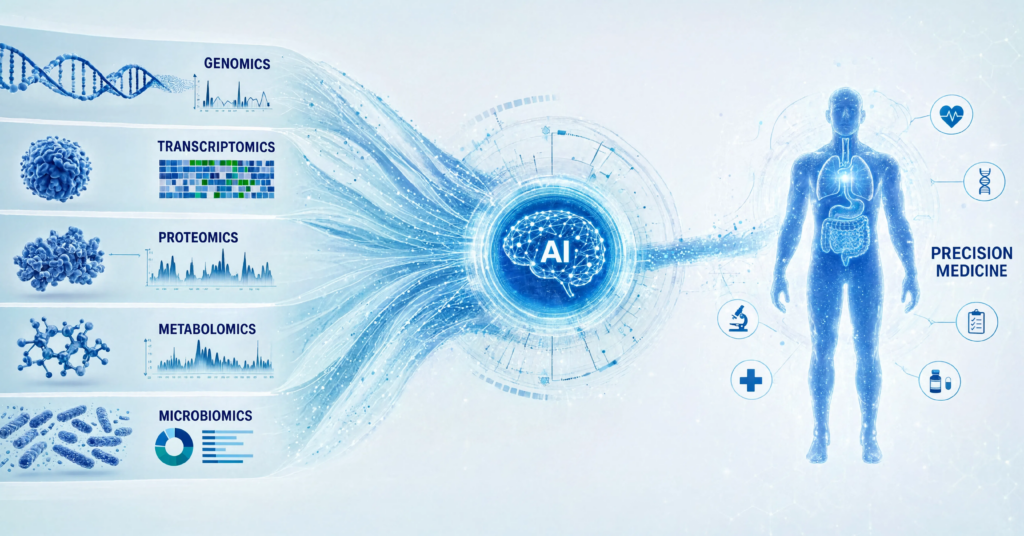
Artificial intelligence is reshaping how researchers analyze complex biological data especially in transcriptomics, imaging, and multi-omics integration.
Advanced tools like MVCLST are improving spatial transcriptomics by combining multiple data layers, while deep learning models are dramatically enhancing medical imaging accuracy and interpretation.
Why It Matters
AI allows researchers to:
- Process huge datasets faster
- Improve accuracy in disease detection
- Identify subtle biological patterns that humans may miss
- Generate reproducible results at scale
CPGR’s Role
We’re integrating AI directly into our workflows to support:
- High-throughput transcriptomics
- Advanced proteomics pipelines
- Automated, data-driven bioinformatics analysis
This helps researchers achieve more precise, high-impact discoveries.
3. CRISPR-Based Diagnostics Are Reshaping Disease Detection
Another powerful trend in the OMICS space is the rise of CRISPR diagnostics tools capable of detecting specific genetic material with exceptional speed and sensitivity.
Technologies like SHERLOCK and DETECTR are revolutionizing point-of-care testing for:
- Infectious diseases
- Cancer
- Genetic conditions
These CRISPR-powered systems enable rapid, cost-effective diagnostics, even in low-resource environments.
Why It Matters
CRISPR diagnostics can deliver accurate results within minutes, opening the door to real-time health monitoring and faster clinical decision-making.
CPGR’s Role
We are actively exploring how CRISPR diagnostics can be integrated into our molecular service offerings to support:
- Faster workflows
- Precision testing
- Scalable, accessible diagnostic innovation
4. What’s Next for CPGR?
These OMICS research trends highlight a rapidly evolving landscape one filled with new opportunities for innovation, impact, and growth.
By staying aligned with key advancements in single-cell research, AI-driven analytics, and CRISPR-based diagnostics, CPGR is committed to:
- Expanding our service portfolio
- Supporting the next wave of African and global life sciences research
- Delivering high-quality, precision-driven molecular solutions
The future of OMICS is unfolding quickly and CPGR is prepared to stay at the forefront.