GWAS South Africa is rapidly emerging as a critical frontier in global genomic science. Genome-Wide Association Studies (GWAS) is an approach to scan the genomes of large populations to identify genetic variants associated with disease risk and complex traits.
Historically, GWAS has been heavily biased toward European populations. This has limited the global applicability of genetic discoveries. South Africa, with its extraordinary genetic diversity, is uniquely positioned to correct this imbalance.
Through advanced infrastructure and international collaborations, the Centre for Proteomic and Genomic Research (CPGR) in Cape Town is enabling high-quality GWAS research that reflects African genomic diversity and improves global precision medicine.
What Is a Genome-Wide Association Study (GWAS)?
A Genome-Wide Association Study (GWAS) is a research approach used to identify associations between genetic variants and specific diseases or traits.
GWAS focuses on single nucleotide polymorphisms (SNPs), which are small variations in DNA that differ between individuals.
By comparing the genomes of individuals with and without a disease, researchers can identify regions of the genome linked to conditions such as:
- Type 2 diabetes
- Cardiovascular disease
- Tuberculosis
- Cancer
- Kidney disease
- Neurological disorders
How GWAS Works?
- Collect DNA samples from large cohorts
- Genotype samples using microarray technology
- Perform statistical association analysis
- Identify significant SNP-disease links
- Validate findings in independent populations
- Translate findings into biological insight
GWAS has enabled the discovery of thousands of disease-associated genetic loci worldwide.
Why GWAS South Africa Matters Globally?
Africa contains the highest level of human genetic diversity on Earth. This makes GWAS South Africa not only locally important but globally essential.
The Problem With Global GWAS Bias
More than 80% of GWAS participants globally are of European ancestry, despite Africa being the origin of all human genetic diversity.
This leads to:
- Reduced accuracy of polygenic risk scores in African populations
- Missed discovery of African-specific variants
- Inequitable precision medicine tools
- Limited global transferability of genetic findings
Why African Genomes Are Scientifically Powerful?
African populations hold a unique and valuable position in human genomic research. With some of the greatest levels of human genetic diversity, African genomes provide critical insights into human variation, disease biology, and precision medicine.
African populations are characterized by:
- Greater genetic diversity – reflecting the deep evolutionary history of human populations in Africa and capturing a wider range of genetic variation, including rare and population-specific variants.
- Shorter linkage disequilibrium (LD) blocks – meaning genetic associations are often confined to smaller genomic regions, allowing researchers to more effectively narrow down regions of interest.
- Improved fine-mapping resolution – enabling scientists to better identify candidate causal variants associated with disease susceptibility, biological traits, and treatment response.
Historically, global genomic datasets have underrepresented African populations, limiting the ability of genomic studies to fully capture human genetic diversity. Increasing African representation in genomic research improves the accuracy, relevance, and inclusivity of discoveries in fields such as:
- Disease genomics and risk prediction
- Pharmacogenomics and personalised medicine
- Population genetics and evolutionary studies
- Biomarker discovery and precision health
By incorporating diverse African genomic datasets, researchers can uncover novel genetic insights and develop more representative tools for understanding health and disease across populations.
African genomic data is not only essential for studying African populations – it is essential for advancing human genomics worldwide.
The Science Behind GWAS
GWAS relies on high-throughput genotyping technologies that measure hundreds of thousands to millions of SNPs across the genome.
These datasets are then analysed using statistical models to identify variants that occur more frequently in individuals with a disease.
The output is often visualised using Manhattan plots, where peaks indicate genomic regions of interest.
CPGR’s Microarray Genotyping Platform
The Centre for Proteomic and Genomic Research (CPGR) provides advanced microarray infrastructure for GWAS South Africa studies.
CPGR delivers end-to-end genotyping services, including DNA processing, data generation, and quality control under ISO 9001:2015 certification.
Core Microarray Instruments
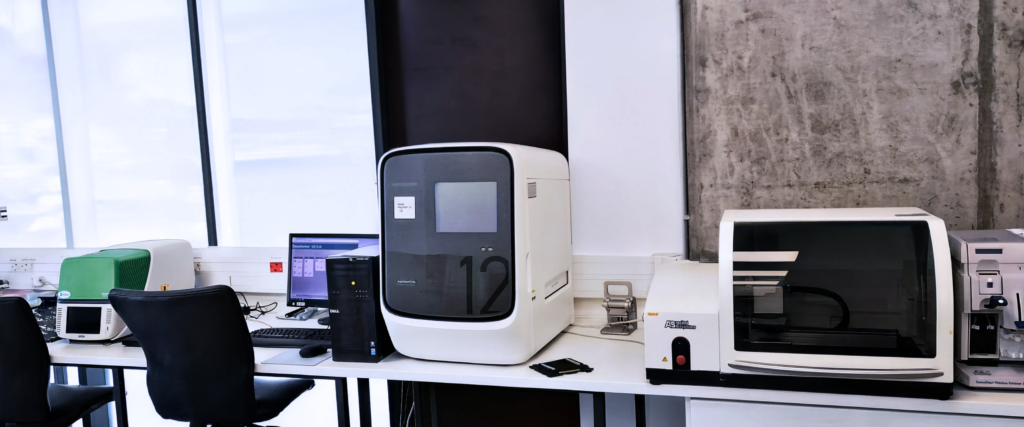
CPGR’s GWAS platform includes:
- GeneTitan™ MC Instrument – automated high-throughput microarray processing system
- iScan™ System – next-generation microarray imaging system for SNP and methylation analysis
These systems enable scalable, reproducible, and high-quality genomic data generation for large cohort studies.
Additional Genomic Capabilities
CPGR also supports:
- Copy number variation (CNV) analysis
- Pharmacogenomics profiling
- Ancestry-informative marker analysis
- Epigenetic (methylation) studies
H3Africa and African Genomic Discovery
One of the most important drivers of GWAS South Africa is the Human Heredity and Health in Africa (H3Africa) Consortium.
This pan-African initiative supports large-scale genomic research across more than 30 African countries.
CPGR plays a key role in this ecosystem by providing access to the Illumina iScan platform for H3Africa-related genotyping projects.
The H3Africa array is specifically designed to capture African genetic variation that is often missed by standard commercial arrays, making it essential for accurate genomic discovery in African populations.
Key GWAS Findings From African Populations
African GWAS studies have already produced important scientific insights:
Cardiometabolic Disease
Studies such as AWI-Gen have identified novel genetic loci associated with:
- Body mass index (BMI)
- Waist-to-hip ratio
- Blood pressure regulation
Tuberculosis Susceptibility
GWAS in South African populations are helping identify genetic factors influencing susceptibility to Mycobacterium tuberculosis infection.
Chronic Kidney Disease
African-specific variants linked to kidney disease risk have been discovered through H3Africa-supported studies.
Pharmacogenomics
GWAS-based pharmacogenomic research is revealing how genetic variation influences drug response in treatments for HIV, TB, and cardiovascular disease.
From GWAS to Precision Medicine
The ultimate goal of GWAS South Africa is clinical translation.
Polygenic Risk Scores
Population-specific polygenic risk scores (PRS) are being developed to improve disease prediction accuracy in African populations.
Pharmacogenomics Applications
GWAS data is being used to optimise:
- Drug selection
- Treatment dosing
- Adverse drug reaction prevention
Drug Discovery
GWAS findings help identify biological pathways and potential drug targets for future therapies.
Challenges and Opportunities in African Genomics
Challenges
- Underrepresentation in global datasets
- High cost of genomic infrastructure
- Limited bioinformatics capacity
- Data sharing and standardisation barriers
Opportunities
- High-resolution genetic discovery
- Improved global genomic diversity representation
- Growth of African precision medicine initiatives
- Expansion of collaborative research networks
The Future of GWAS in South Africa
GWAS South Africa is reshaping global genomics by integrating African genetic diversity into disease research.
Through advanced microarray infrastructure and international collaborations, CPGR enables high-quality genomic data generation that supports both discovery science and clinical translation.
As African datasets continue to grow, GWAS will play a central role in delivering more accurate, equitable, and effective precision medicine worldwide.
Partner With CPGR
CPGR offers end-to-end GWAS and genotyping services including study design support, DNA processing, microarray analysis, and bioinformatics reporting.
Contact CPGR to accelerate your genomic research project. Book a consultation with our team to discuss your GWAS study design, data needs, and end-to-end genomics support. https://www.cpgr.org.za/cpgr-connect/#free