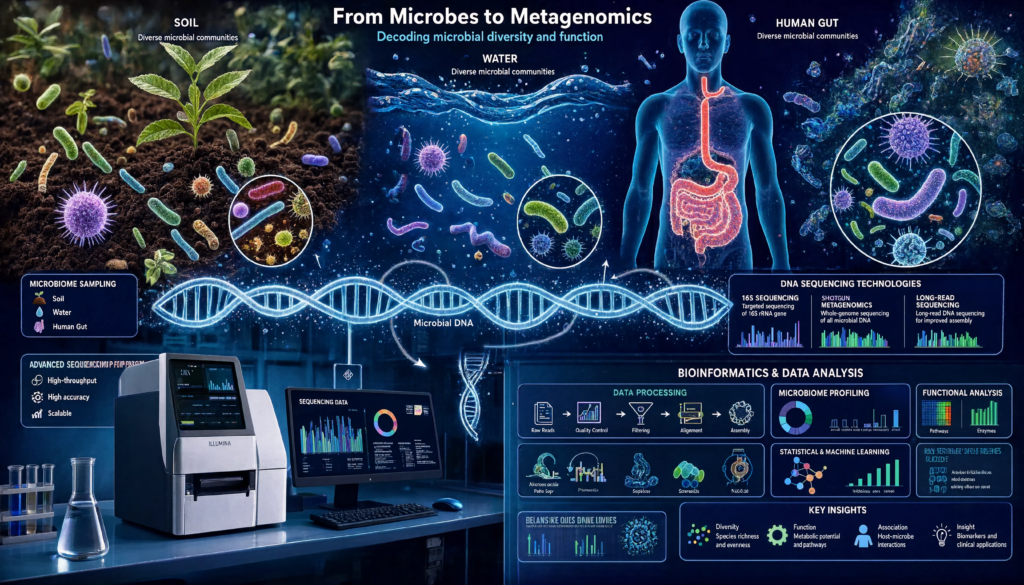
What Is Microbial Sequencing?
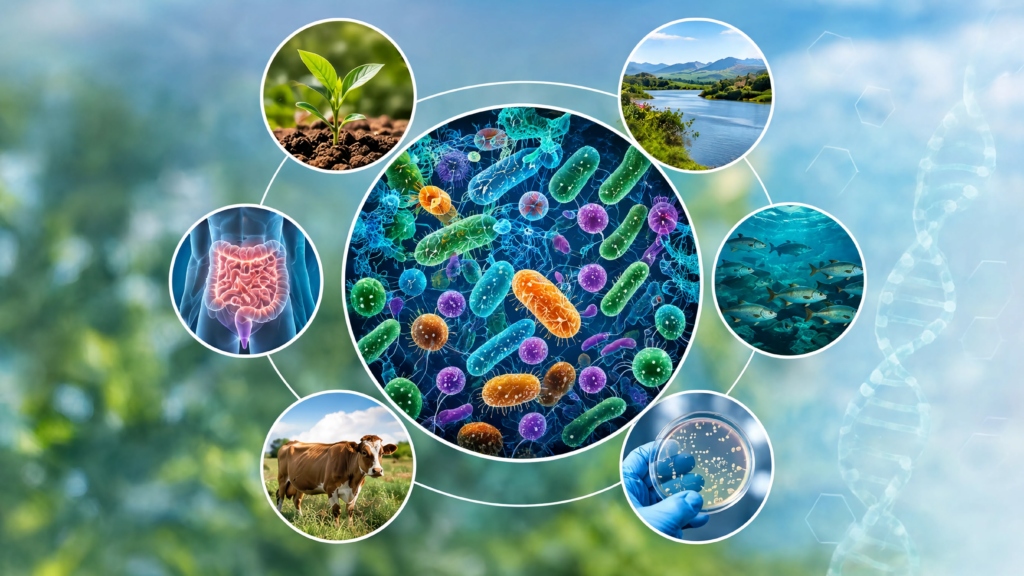
Metagenomics sequencing has transformed the way scientists study microorganisms by allowing entire microbial communities to be analysed directly from environmental or clinical samples, without the need to culture organisms in the laboratory.
Traditional microbiology depends on growing microorganisms under laboratory conditions before they can be identified. However, many microbes cannot be cultured using standard techniques, meaning researchers have historically observed only a small fraction of microbial diversity.
Metagenomics overcomes this limitation by sequencing DNA extracted directly from samples such as soil, water, food, wastewater, plant material, animal tissues, and human clinical specimens. Instead of studying a single organism in isolation, researchers can examine every microorganism present within a complex community.
Today, metagenomics sequencing is driving discoveries across medicine, agriculture, environmental science, food safety, veterinary medicine, and biotechnology. Researchers use it to investigate infectious diseases, monitor antimicrobial resistance, study the human microbiome, identify novel microorganisms, and understand how microbial communities influence health and ecosystems.
As sequencing technologies continue to evolve, one of the most common questions researchers face is:
Should I use 16S sequencing or shotgun metagenomics?
While both approaches are valuable, they answer different scientific questions and generate different types of data. Selecting the appropriate method depends on your research objectives, budget, required taxonomic resolution, and downstream analyses.
Why Microbiomics Matters
Microorganisms are fundamental to nearly every biological process on Earth. They regulate nutrient cycling, influence crop productivity, affect climate processes, protect ecosystems, and play essential roles in human, animal and environmental health.
Within the human body alone, trillions of microorganis collectively form the microbiome, contributing to digestion, immune regulation, metabolism, and disease susceptibility. Changes in microbial communities have been associated with numerous conditions, including inflammatory bowel disease, obesity, diabetes, cancer, respiratory diseases, and neurological disorders.
Beyond healthcare, metagenomics supports research in:
- Agricultural productivity and soil health
- Plant disease diagnostics
- Livestock health
- Food quality and safety
- Wastewater surveillance
- Marine and freshwater ecology
- Wildlife conservation
- Environmental monitoring
- Industrial biotechnology
As research questions become increasingly complex, choosing the right sequencing strategy has become one of the most important decisions in microbiome research.
Understanding 16S Sequencing
16S sequencing is one of the most widely used approaches for studying bacterial communities.
Rather than sequencing every DNA fragment in a sample, this method targets the 16S ribosomal RNA (rRNA) gene, a highly conserved genetic marker found in bacteria and archaea. The gene contains both conserved and variable regions, allowing scientists to distinguish between different bacterial groups while using universal primers to amplify the target region.
Once amplified using PCR, the DNA is sequenced and compared against reference databases to determine which bacterial taxa are present.
Because only a single marker gene is sequenced, 16S sequencing generates relatively small datasets that are easier and faster to analyse than whole-community sequencing.
Advantages of 16S Sequencing
Researchers continue to use 16S sequencing because it offers several important advantages:
- Data generated for Bacterial population only
- Established analytical workflows
- Suitable for large population studies
- Efficient bacterial community profiling
- Reduced computational requirements
These benefits make 16S sequencing an attractive option for exploratory microbiome studies or projects involving hundreds or thousands of samples.
Limitations of 16S Sequencing
Although highly valuable, 16S sequencing has important limitations such as:
- Only provides information about a small marker region
- Closely related species may not be distinguishable
- Cannot directly determine functional capability
- PCR amplification introduces primer and amplification biases
- Does not recover genomes.
In addition, taxonomic identification is often limited to the genus level, with species-level classification remaining difficult for many organisms.
Perhaps most importantly, 16S sequencing cannot determine the functional capabilities of microbial communities. It identifies who is present, but not necessarily what those organisms are capable of doing.
Understanding Shotgun Metagenomics
Shotgun metagenomics provides a far more comprehensive view of microbial communities.
Instead of sequencing a single marker gene, shotgun metagenomics sequences all DNA present within a sample. Every genetic fragment extracted from bacteria, archaea, fungi, viruses, parasites, and other organisms is sequenced simultaneously.
This untargeted approach generates a complete genetic snapshot of the microbial ecosystem.
Because the entire genetic content is analysed, researchers can investigate:
- Species composition
- Strain-level variation
- Functional genes
- Metabolic pathways
- Virulence factors
- Antimicrobial resistance genes
- Mobile genetic elements
- Novel microorganisms
Shotgun metagenomics therefore provides both taxonomic and functional information.
Rather than simply identifying which microorganisms are present, researchers can determine how microbial communities function and interact within their environment.
This has made shotgun metagenomics the preferred approach for advanced microbiome research, infectious disease surveillance, antimicrobial resistance monitoring, precision medicine, and environmental genomics.
Applications of Shotgun Metagenomics
Shotgun metagenomics supports an exceptionally broad range of research applications, including:
Human Microbiome Research
Researchers investigate how microbial communities influence human health and disease by analysing the complete genetic content of gut, oral, skin, respiratory, and urogenital microbiomes.
Infectious Disease Surveillance
Shotgun sequencing enables simultaneous detection of multiple pathogens within a single sample, making it particularly valuable for outbreak investigations and emerging infectious diseases.
Antimicrobial Resistance Monitoring
By identifying antimicrobial resistance genes directly from environmental or clinical samples, shotgun metagenomics supports global efforts to combat antimicrobial resistance.
Agricultural Research
Scientists study soil microbial diversity, plant-associated microbiomes, and livestock health to improve crop productivity, sustainability, and food security.
Environmental Monitoring
Microbial communities provide valuable indicators of ecosystem health. Shotgun sequencing helps researchers monitor biodiversity, pollution, wastewater quality, and environmental restoration projects.
Advantages of Shotgun Metagenomics Sequencing
Shotgun Metagenomics provides a comprehensive microbial profile of the sample and offers the following advantages:
Captures the entire microbial DNA content, including bacteria, archaea, fungi, viruses, and plasmids.
- Captures the entire microbial DNA content, including bacteria, archaea, fungi, viruses, and plasmids.
- Identifies genes involved in metabolism, antimicrobial resistance, virulence, environmental adaptation, biogeochemical pathways.
- Enables assembly of microbial genomes from environmental samples. Supports discovery of novel organisms and metabolic pathways.
- Can distinguish organisms beyond the limitations of marker-gene approaches.
Limitations of Shotgun Metagenomics Sequencing
- Requires greater sequencing depth.
- More computationally demanding.
- DNA extraction quality is critical.
- Environmental samples may contain large amounts of non-target DNA (e.g., host DNA, soil DNA, contaminants).
16S vs Shotgun Metagenomics: What’s the Difference?
Although both methods fall under the umbrella of metagenomics sequencing, they are designed to answer different research questions.
Choosing the right approach depends on your project objectives, the level of detail required, and your available budget.
| Feature | 16s | Shotgun Metagenomics |
| DNA Target | 16S rRNA gene only | All DNA within the sample |
| Organisms Detected | Primarily bacteria and archaea | Bacteria, archaea, fungi, viruses, protozoa and other microorganisms |
| Taxonomic Resolution | Typically genus level | Species and strain level |
| Functional Analysis | No | Yes |
| Antimicrobial Resistance Detection | No | Yes |
| Novel Organism Discovery | Limited | Excellent |
| Data Complexity | Low | High |
| Bioinformatics Requirements | Moderate | Advanced |
| Cost | Lowe | Higher |
| Best For | Microbiome profiling | Comprehensive microbial community analysis |
While 16S sequencing provides an efficient overview of bacterial diversity, shotgun metagenomics delivers a much richer understanding of microbial communities by revealing both who is present and what they are capable of doing.
Which Microbiomics Sequencing Method Should You Choose?
There is no universally “better” sequencing method. Instead, the right choice depends entirely on your scientific question.
Choose 16S Sequencing if you need to:
- Characterise bacterial community composition
- Compare microbial diversity between samples
- Conduct large-scale microbiome surveys
- Work within a limited sequencing budget
- Perform preliminary exploratory studies
16S sequencing is particularly suitable for routine microbiome profiling where bacterial identification is the primary objective.
Choose Shotgun Metagenomics if you need to:
- Identify bacteria, fungi, viruses and parasites simultaneously
- Achieve species- or strain-level identification
- Detect antimicrobial resistance genes
- Analyse metabolic pathways
- Investigate microbial functions
- Discover previously unknown microorganisms
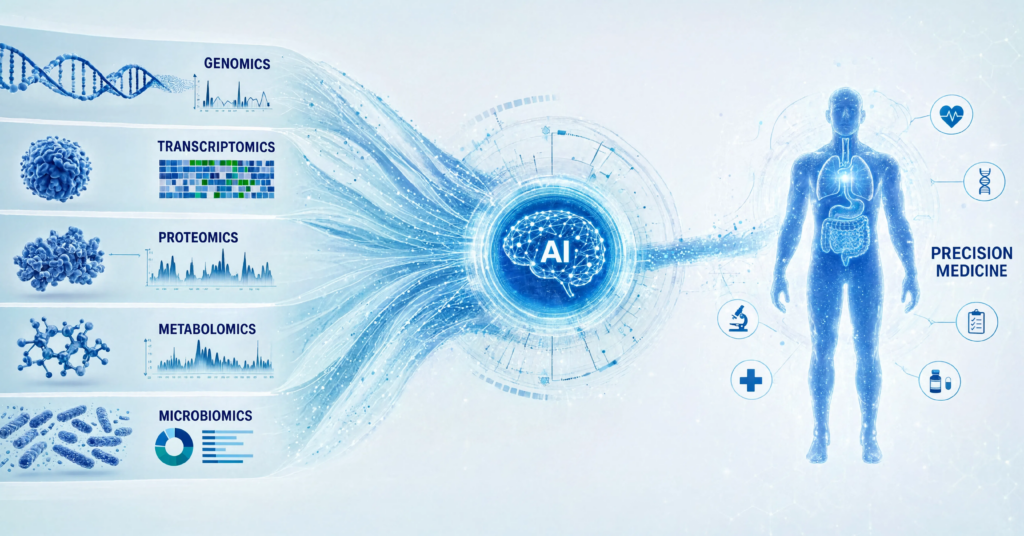
- Support precision medicine research
- Generate publication-quality multi-OMICS datasets
For researchers seeking the most comprehensive understanding of microbial communities, shotgun metagenomics has become the preferred approach.
How Long-Read Sequencing Is Transforming Metagenomics
The rapid adoption of long-read sequencing is redefining what is possible in metagenomics research.
Traditional short-read technologies produce highly accurate reads but often struggle to assemble complex microbial genomes because DNA is fragmented into short pieces before sequencing.
Long-read sequencing platforms, such as the Oxford Nanopore PromethION24, generate reads that span thousands or even hundreds of thousands, of base pairs. These longer reads make it easier to reconstruct complete microbial genomes, resolve repetitive regions, identify structural variations and accurately characterise highly complex microbial communities.
For shotgun metagenomics, long-read sequencing offers several important advantages:
- Improved genome assembly
- Better species and strain resolution
- More accurate identification of antimicrobial resistance genes
- Detection of plasmids and mobile genetic elements
- Enhanced viral genome reconstruction
- Simultaneous methylation profiling without additional library preparation
- Improved discovery of novel microorganisms
These capabilities are particularly valuable when analysing environmental samples, wastewater, soil, plant microbiomes and complex clinical specimens where multiple closely related organisms may coexist.
As sequencing technologies continue to advance, combining long-read sequencing with robust bioinformatics is enabling researchers to generate deeper biological insights than ever before.
Why Bioinformatics Matters in Metagenomics Sequencing
Generating sequencing data is only the beginning.
Modern metagenomics studies produce millions or even billions of DNA reads. Transforming these raw sequences into meaningful biological insights requires advanced computational analysis.
Bioinformatics enables researchers to:
- Perform quality control
- Remove host contamination
- Assemble microbial genomes
- Assign taxonomy
- Identify functional genes
- Detect antimicrobial resistance markers
- Compare microbial diversity between samples
- Visualise microbial communities
- Generate publication-ready results
Without appropriate bioinformatics pipelines, valuable biological information can remain hidden within enormous sequencing datasets.
This is why sequencing and bioinformatics should always be considered together when planning a metagenomics project.
How CPGR Supports Microbiomics Research
At the Centre for Proteomic and Genomic Research (CPGR), we provide comprehensive metagenomics sequencing solutions that support researchers from project conception through to biological interpretation.
Rather than offering sequencing as a standalone service, CPGR delivers an integrated workflow that includes consultation, sample preparation, sequencing, quality assurance and advanced bioinformatics analysis.
Our metagenomics capabilities support research across:
- Human microbiome studies
- Infectious disease surveillance
- Environmental microbiology
- Agricultural genomics
- Food safety
- Veterinary research
- Biodiversity and conservation
- Public health surveillance
Researchers can choose between targeted microbial profiling using 16S sequencing or comprehensive microbial characterisation through shotgun metagenomics, depending on the objectives of their study.
Where appropriate, CPGR also supports long-read sequencing workflows using advanced Oxford Nanopore Technologies to improve genome assembly, strain resolution and functional analysis.
By combining state-of-the-art sequencing platforms with experienced scientists and bioinformaticians, CPGR helps researchers generate reliable, publication-quality data that drives scientific discovery.
Book a Consultation
Planning a Metagenomics Sequencing Project?
Choosing between 16S sequencing and shotgun metagenomics can significantly influence the quality and impact of your research. Whether you’re studying the human microbiome, environmental ecosystems, agricultural samples or infectious diseases, selecting the right sequencing strategy is essential.
CPGR provides end-to-end metagenomics sequencing services from project planning and sample preparation to sequencing and advanced bioinformatics analysis. Our team works closely with researchers to recommend the most appropriate workflow for each project, ensuring high-quality data and meaningful biological insights.
Book a free consultation today to discuss your project and discover how CPGR can support your next metagenomics study. https://calendly.com/justin-naicker-cpgr/cpgr-chat