Understanding cancer in Africa requires more than data, it requires infrastructure, accuracy, and technology that works reliably across diverse conditions. At the Centre for Proteomics & Genomics Research (CPGR), we support this mission through advanced microarray genotyping, a platform that has proven essential in large-scale population studies such as the Men of African Descent and Carcinoma of the Prostate (MADCaP) Network.
Microarrays allow researchers to analyse thousands of genetic markers simultaneously, offering a fast, accurate, and cost-effective path to understanding disease risk and population diversity. And in Africa, where cancer rates are rising and genomic data remains limited, these insights are crucial.
Why Microarrays Matter in Africa’s Precision Medicine Journey
Microarrays are powerful tools for high-throughput genotyping, making it possible to screen DNA samples for hundreds of thousands of variants at once. This technology is especially valuable in projects where large cohorts must be analysed quickly without compromising data quality.
In studies across sub-Saharan Africa, microarrays have enabled researchers to:
- Identify genetic markers linked to disease risk
- Compare genetic variation across populations
- Validate ancestry and sample integrity
- Generate standardised datasets for multi-centre research collaborations
This reliability is exactly why microarrays became a cornerstone of the MADCaP study, one of the largest cancer genomics efforts ever conducted in Africa.
CPGR’s Role in the MADCaP Network: Building a Genomics Backbone for Africa
The MADCaP Network brings together seven research centres across Ghana, Nigeria, Senegal, and South Africa, partnered with leading U.S. institutions, to study the genetics and epidemiology of prostate cancer. Prostate cancer remains the most common male cancer in sub-Saharan Africa, with mortality expected to double by 2035.
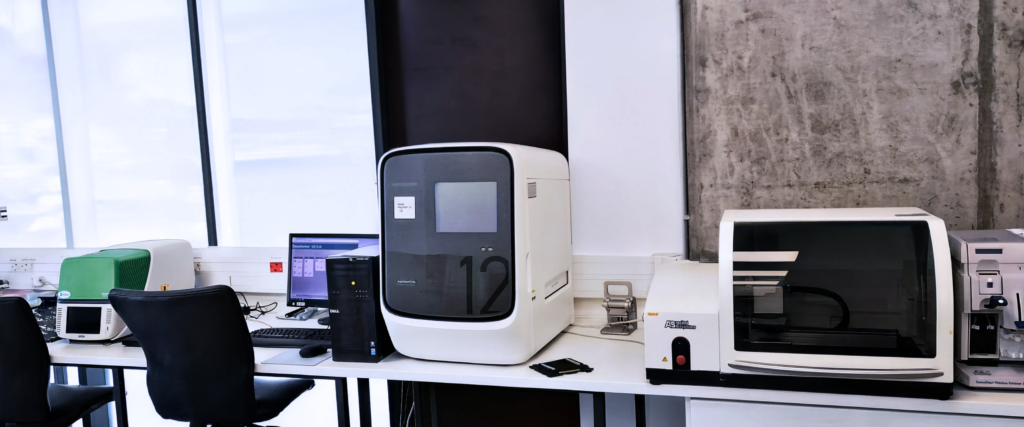
microarray.
To support this effort, CPGR served as a central genotyping hub, working alongside the Center for Inherited Disease Research (CIDR) in the United States. Using robust microarray workflows, including the UK Biobank Axiom Array, CPGR delivered:
- High-quality genotyping across diverse sample types
- Concordance rates matching U.S. benchmarks
- Quality control support for all African study sites
- Long-term biobanking and sample processing
The result? CPGR demonstrated that Africa can generate world-class genotyping outputs, enabling population-scale cancer research with scientific integrity and consistent quality.
High-Quality DNA, High-Quality Data
Not all DNA samples are created equal, but microarrays helped make them usable.
Samples for the MADCaP Network came from whole blood, buffy coat, and buccal swabs collected across seven study sites. Despite differences in infrastructure and sample storage conditions, microarray genotyping produced strong results:
- 95–100% genotype success rates for blood-derived DNA
- Consistent high-quality genotyping across CPGR and CIDR labs
- Reliable performance even with varying DNA purity readings
This demonstrated that microarrays are resilient and adaptable, making them ideal for research environments where sample quality may vary.
Standardising Genomic Research Across Africa
One of the key achievements of the MADCaP initiative was the creation of a standardised genomic workflow across all participating centres.
Microarrays played a critical role by enabling:
- Unified genotyping across multiple countries
- Harmonised quality control metrics
- Shared data formats for large-scale analysis
- Scalable processing for both pilot and expanded cohorts
By achieving high concordance between CPGR and CIDR, the microarray platform proved essential in validating Africa’s readiness for precision oncology and population genomics.
What This Means for Future African Genomic Studies
The success of microarray-based genotyping in MADCaP marks a turning point for African biomedical research:
- Large-scale genomic studies can be conducted reliably within Africa
- African data can be generated at global quality standards
- Researchers now have the infrastructure to expand into GWAS, ancestry studies, and disease biomarker discovery
- More equitable representation in global genomics becomes possible
CPGR’s microarray platform is now a proven foundation for future population-scale research, enabling scientists to explore the genetic architecture of cancer, non-communicable diseases, and population diversity across the continent.
CPGR’s Microarray Platform: High-Throughput Genotyping for African Research
Whether you’re conducting case–control studies, ancestry analysis, biomarker discovery, or large-scale epidemiological research, CPGR offers:
✔ High-throughput microarray genotyping
✔ UK Biobank Axiom Array & other global-standard chips
✔ ISO-accredited workflows
✔ Expert quality control and sample validation
✔ Secure, compliant biobanking
✔ Support across pilot and full-scale studies
Our team works with African and international partners to deliver consistent, reliable, and publication-ready genomic data every time.
Drive your research forward with high-quality, Africa-ready genomic data.
Connect with CPGR to access validated microarray workflows and expert support for your study – Microarray services