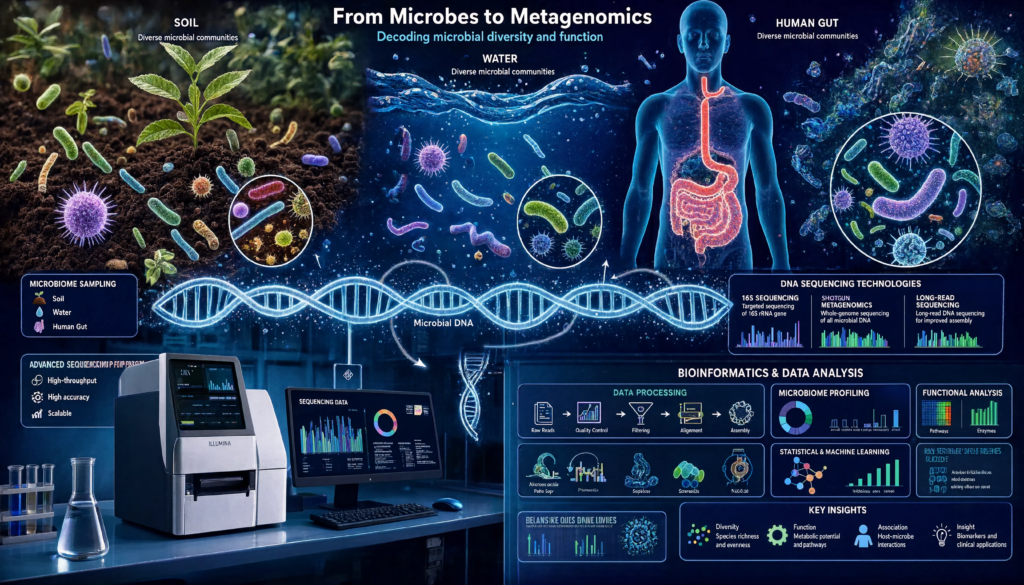
Microbiology research today depends on genetic insight. Whether profiling complex microbial communities via 16S rRNA and ITS targeted metabarcoding, or probing functional potential with shotgun metagenomics, genomic data is central to scientific discovery.
Yet many researchers in South Africa and other under-represented regions face persistent hurdles: limited sequencing infrastructure, high costs, data analysis bottlenecks, and funding constraints. At the same time, microbial ecosystems – from soil to fermented foods, plant rhizospheres to wastewater microbiomes – harbour vast biological potential that conventional workflows have only partially revealed.
This is where Long-Read Sequencing (LRS) plays a pivotal role. By generating long, contiguous reads of DNA, LRS helps overcome barriers inherent in short-read sequencing and culture-based methods, unlocking deeper insight into taxonomy,
Microbiology Research: From Targeted Metabarcoding to Deep Functional Insight
Targeted metabarcoding using markers such as the 16S rRNA gene (for bacteria and archaea) and the Internal Transcribed Spacer (ITS) regions (for fungi) remains indispensable for microbial profiling. These workflows are widely for the following reasons:
- Cost‑effective and scalable
- Reliable taxonomic composition of complex microbiomes
- Support comparative studies across samples and environments
However, targeted metabarcoding has limitations. Because it focuses on predefined regions, it cannot capture:
- Functional genes outside marker loci
- Structural genome variation
- Microbial species with nearly identical marker sequences
- Mobile genetic elements like plasmids and phages
Shotgun metagenomics expands the view by sequencing entire microbial genomes directly from environmental DNA, enabling functional annotation and ecosystem‑level insight. Whereas short‑read shotgun (e.g., 150–300 bp) often yields fragmented assemblies; making it difficult to resolve gene clusters, distinguish closely related strains, or link functional traits to individual taxa.
Why Long‑Read Sequencing Matters for Microbiology?
Long‑Read Sequencing (LRS) – sometimes called third‑generation sequencing -changes this paradigm by reading DNA molecules that are orders of magnitude longer than traditional short reads. For microbial research, this has concrete advantages:
- Full‑Length 16S and ITS Resolution
Long reads enable sequencing of entire 16S rRNA operons and full ITS regions in a single pass, increasing species‑ and strain‑level resolution over amplicon workflows that can miss subtle sequence differences.
- Comprehensive Shotgun Metagenomics
Unlike short‑read assemblers that piece together fragments, LRS can:
- Generate near‑complete microbial genomes
- Identify structural variants and genomic islands
- Link functional genes to their host organisms
- Reveal plasmids and mobile elements
This is particularly valuable in complex communities where functional interpretation matters, such as antibiotic resistance profiling, biosynthetic gene cluster discovery, and metabolic pathway reconstruction.
- Detection of Hard‑to‑Culture and Rare Taxa
Many microbes – including viable but non‑culturable (vBNC) strains – evade traditional culturing. LRS, with its long, contiguous reads, improves the likelihood of detecting these organisms in shotgun metagenomes.
- Epigenetic Insight (Native Sequencing)
Long‑Read platforms like Oxford Nanopore can sequence DNA natively, preserving methylation patterns and other modifications that are invisible to amplification‑based workflows. This adds another layer of functional data for nuanced microbiome studies.
Research Pain Points in South Africa
South African microbiologists – from agricultural genomics labs to environmental microbiome groups and biomedical research units – share familiar challenges:
- Funding Constraints
Sequencing budgets are often limited, with high costs for outsourcing short‑read sequencing abroad, reagent importation fees, and competitive grant cycles. This constrains sample throughput and delays project timelines.
- Infrastructure Bottlenecks
Access to high‑throughput sequencers, long‑read platforms, or local data analysis capacity can be limited. Many researchers must rely on overseas facilities, increasing cost and turnaround times while losing local data sovereignty.
- Bioinformatics Burden
Shotgun metagenomics data is complex. Without local support for long‑read assembly tools, taxonomic classification pipelines, and functional annotation workflows, researchers struggle to derive actionable insights.
- Under‑representation in Reference Databases
Microbiome reference databases are heavily biased toward North American and European samples. South African soil, plant, animal, and environmental microbiomes – often more diverse – are underrepresented, resulting in misclassification or incomplete annotation.
How CPGR Overcomes These Pain Points?
LRS delivers multiple advantages that align with researcher needs:
- Local sequencing reduces dependency on international services and cuts turnaround times.
- Native and full‑length sequencing enhances data quality and functional interpretation.
- High‑resolution genomes mean better assemblies and fewer ambiguous classifications.
- Optimized workflows (16S/ITS full‑length, shotgun metagenomics) support both taxonomic and functional research outcomes.
Across sectors -from agricultural microbiomes that influence crop yield to industrial microbial bioprocessing and environmental monitoring – LRS enables researchers to do more with the same or fewer resources.
The CPGR Approach to Microbial Sequencing
At CPGR, we provide:
- Expert design and optimisation of LRS workflows
- Full‑length 16S rRNA and ITS sequencing
- PCR‑free shotgun metagenomics
- Sample preparation and sequencing on long‑read platforms
- Native DNA sequencing where applicable
- Library construction tailored to project goals
- Scalable bioinformatics pipelines
- Assembly, binning, taxonomic classification
- Functional annotation and pathway analysis
- Consultative support aligned with funding cycles and grant applications
- Budget estimates for proposals
- Technical strategy for high‑impact research outcomes
Attention‑Grabbing Stat Insights
- ~99% of environmental microbes cannot be cultured using traditional methods, making culture‑independent sequencing essential.
- A typical microbiome can contain 3–10 million genes, vastly more than the ~20,000 genes in the human genome.
- <5% of global microbiome research data originates from African or indigenous contexts, a stark gap LRS can help address.
Microbiology research is evolving – and so should your sequencing strategy.
👉 Schedule a consultation https://calendly.com/justin-naicker-cpgr/cpgr-chat or inquire about pricing https://www.cpgr.org.za/register-project/ on CPGR’s NGS platform and long‑read sequencing services today.