The demand for DNA sequencing services in South Africa has grown rapidly over the past decade as advances in genomics continue to reshape research, healthcare, agriculture, conservation, and biotechnology. Researchers now rely on DNA sequencing not only to study genes, but also to understand entire genomes, identify disease-causing variants, investigate microbial communities, improve crop resilience, monitor emerging pathogens, and support precision medicine.
With so many sequencing technologies available, however, selecting the right approach can be challenging. Should you choose Whole Genome Sequencing, Whole Exome Sequencing, Amplicon Sequencing, or Shotgun Metagenomics? Is short-read sequencing sufficient, or will long-read sequencing provide greater insight?
Each method is designed to answer different scientific questions. Choosing the wrong approach can lead to unnecessary costs, incomplete datasets, or missed biological discoveries. Choosing the right one ensures your research generates meaningful, high-quality data that supports confident decision-making and publication.
At the Centre for Proteomic and Genomic Research (CPGR), we help researchers identify the most suitable sequencing strategy for their project. From study design and sample preparation to sequencing and advanced bioinformatics, our team provides end-to-end support that enables researchers across South Africa and beyond to maximise the value of their genomic data.
This guide explains the most widely used DNA sequencing methods, their strengths, limitations, and ideal applications, helping you choose the sequencing solution that best aligns with your research objectives.
What Is DNA Sequencing?
DNA sequencing is the process of determining the precise order of nucleotides ,adenine (A), thymine (T), cytosine (C), and guanine (G), within a DNA molecule. This genetic code contains the biological instructions that govern how organisms develop, function, and respond to their environment.
By reading DNA sequences, researchers can identify genetic variations, detect disease-associated mutations, study evolutionary relationships, investigate microbial communities, and uncover the molecular mechanisms underlying health and disease.
Modern DNA sequencing has become an indispensable tool across numerous fields, including:
- Human health and precision medicine
- Cancer genomics
- Infectious disease surveillance
- Rare disease diagnosis
- Agricultural genomics
- Veterinary medicine
- Microbiome research
- Conservation biology
- Environmental genomics
- Pharmaceutical research
The ability to sequence DNA rapidly, accurately, and at scale has transformed life sciences, enabling discoveries that were unimaginable just two decades ago.
DNA Sequencing Technologies: From First Generation to Current
DNA sequencing technologies have evolved significantly since the introduction of Sanger sequencing in the 1970s.
First-Generation Sequencing
Sanger sequencing laid the foundation for modern genomics and remains valuable for validating individual DNA variants. However, because it sequences one DNA fragment at a time, it is not practical for analysing whole genomes or large-scale studies.
Next-Generation Sequencing (NGS)
Next-Generation Sequencing revolutionised genomics by allowing millions of DNA fragments to be sequenced simultaneously.
NGS dramatically increased throughput and while reducing sequencing costs, making large-scale genomic studies possible. Today, it underpins applications such as:
- Whole Genome Sequencing
- Whole Exome Sequencing
- RNA Sequencing
- Amplicon Sequencing
- Targeted Panels
- Metagenomics
NGS remains the backbone of modern genomic research due to its speed, scalability, and accuracy.
Third-Generation Sequencing
More recently, third-generation sequencing, also known as long-read sequencing, has further expanded genomic capabilities.
Unlike short-read technologies that analyse DNA in small fragments, long-read sequencing reads DNA molecules spanning thousands or even hundreds of thousands of bases in a single read.
This enables researchers to:
- Assemble genomes more accurately
- Resolve repetitive genomic regions
- Detect structural variants
- Sequence highly complex genomes
- Analyse epigenetic modifications
- Improve metagenomic assembly
Rather than replacing Next-Generation Sequencing, long-read sequencing complements it, giving researchers access to deeper genomic insights when projects demand greater resolution.
Choosing the Right DNA Sequencing Strategy
One of the most common misconceptions is that there is a single “best” sequencing method. In reality, the ideal approach depends entirely on the biological question being asked.
Before selecting a sequencing service, researchers should consider:
- What question am I trying to answer?
- Am I studying a whole Genome or specific genes of the organism?
- Do I need to discover new variants or analyse known targets?
- Am I working with a single organism or an entire microbial community?
- What level of resolution is required?
- How many samples will be analysed?
- What bioinformatics support will be needed?
The answers to these questions determine which sequencing strategy will provide the greatest scientific value.
In the following sections, we’ll explore the most widely used DNA sequencing services and explain when each method is the right choice.
Whole Genome Sequencing (WGS)
Whole Genome Sequencing provides the most comprehensive view of an organism’s DNA by analysing its entire genome.
Rather than focusing only on selected genes, WGS captures coding and non-coding regions, structural variants, copy number changes, mitochondrial DNA, and many other forms of genetic variation.
Researchers choose WGS when they need the fullest possible picture of genetic information.
Whole Genome Sequencing is ideal for:
- Discovery approach (new or ungenotyped species)
- Rare disease research
- Cancer genomics
- Population genetics
- Pathogen surveillance
- Agricultural breeding programmes
- Conservation genomics
- Evolutionary biology
- Precision medicine
Because every part of the genome is sequenced, WGS offers unmatched flexibility for future analyses, allowing researchers to revisit existing datasets as new discoveries emerge.
Its comprehensive nature has made Whole Genome Sequencing one of the most powerful tools in modern genomics.
Whole Exome Sequencing (WES)
While Whole Genome Sequencing analyses an organism’s complete DNA, Whole Exome Sequencing (WES) focuses specifically on the exome, the approximately 1–2% of the genome that contains protein-coding genes.
Although the exome represents only a small fraction of the genome, it contains the majority of known disease-causing genetic variants. This makes WES a highly efficient and cost-effective solution for many human genetics studies.
Researchers commonly choose Whole Exome Sequencing when investigating inherited disorders, identifying disease-causing mutations, or analysing clinical samples where the focus is on protein-coding genes.
Whole Exome Sequencing is commonly used for:
- Rare disease research
- Clinical genomics
- Precision medicine
- Cancer genomics
- Variant discovery
- Mendelian disease studies
- Pharmacogenomics
Compared with Whole Genome Sequencing, WES generates smaller datasets, simplifying downstream bioinformatics analysis while still capturing the majority of clinically relevant variants.
However, because non-coding regions are not sequenced, variants outside the exome will not be detected. For projects requiring complete genomic coverage, Whole Genome Sequencing remains the preferred approach.
Amplicon Sequencing
Sometimes researchers are interested in analysing only a small number of genes or genomic regions rather than sequencing an entire genome.
In these situations, Amplicon Sequencing provides an efficient targeted approach.
Amplicon sequencing involves PCR amplification of specific DNA regions before sequencing. By focusing only on areas of interest, researchers obtain very deep sequencing coverage, enabling the detection of low-frequency variants with exceptional accuracy.
This targeted strategy offers faster turnaround times, reduced costs, and simplified data analysis compared with genome-wide sequencing.
Amplicon Sequencing is ideal for:
- Targeted metabarcoding (16S, ITS, COI metagenomics)
- Targeted mutation analysis
- Cancer hotspot panels
- Pathogen identification
- Antimicrobial resistance surveillance
- Validation of NGS discoveries
- Genetic screening
- Population studies
Because only selected genomic regions are analysed, Amplicon Sequencing is best suited to projects where the targets are already known. It is not intended for discovering novel variants across the genome.
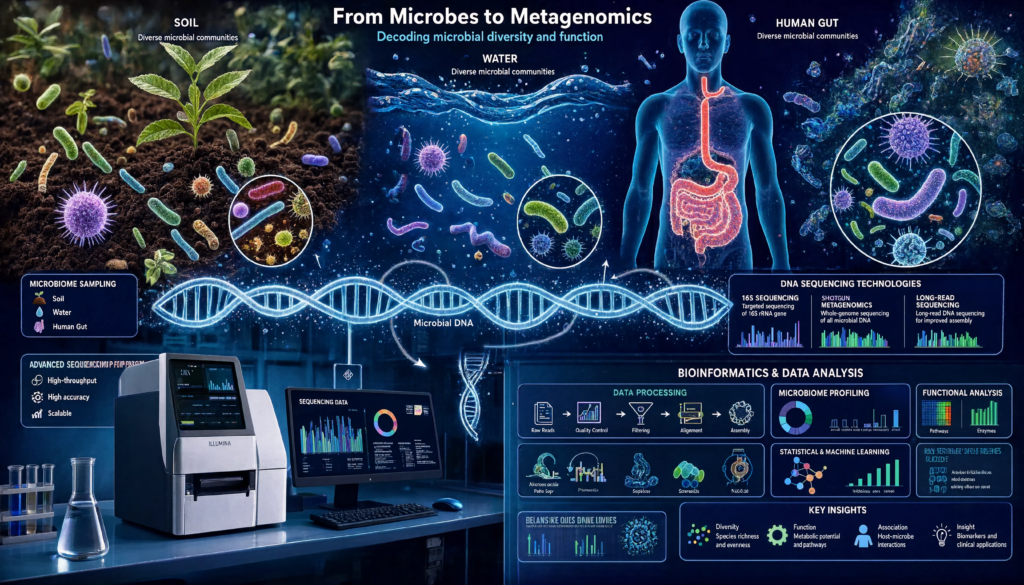
Shotgun Metagenomics
Unlike traditional sequencing approaches that focus on a single organism, Shotgun Metagenomics analyses all genetic material present within a sample.
DNA extracted from soil, water, food, wastewater, plant material, or clinical specimens is sequenced without targeting a specific organism. This provides a comprehensive overview of entire microbial communities, including bacteria, viruses, fungi, archaea, and other microorganisms.
Rather than asking whether a particular organism is present, shotgun metagenomics answers broader questions about microbial diversity, function, and interactions.
Shotgun Metagenomics is widely used for:
- Human microbiome research
- eDNA research
- Wastewater surveillance
- Infectious disease investigations
- Food safety testing
- Agricultural microbiome studies
- Biodiversity research
- Antimicrobial resistance monitoring
One of the greatest strengths of shotgun metagenomics is its ability to reveal not only which microorganisms are present but also the genes they carry, the metabolic pathways they use, and the functional roles they play within complex ecosystems.
For researchers investigating microbial communities in depth, shotgun metagenomics has become one of the most powerful sequencing approaches available.
Long-Read Sequencing
Recent advances in genomics have introduced Long-Read Sequencing, often referred to as third-generation sequencing.
Unlike conventional short-read sequencing, which reads DNA in fragments of a few hundred base pairs, long-read technologies can sequence DNA molecules spanning tens of thousands or even hundreds of thousands of base pairs in a single read.
This dramatically improves the ability to assemble complete genomes, resolve repetitive regions, detect structural variants, and characterise complex genomic rearrangements.
Long-read sequencing is particularly valuable for:
- Whole Genome Sequencing
- Structural variant detection
- Repeat expansion disorders
- Haplotype phasing
- Methylation profiling
- Transcript isoform analysis
- Long-read metagenomics
- De novo genome assembly
At CPGR, long-read sequencing capabilities enable researchers to tackle projects that are difficult or impossible using short-read technologies alone, delivering deeper genomic insights for human, agricultural, microbial, and environmental research.
Which DNA Sequencing Service Is Right for You?
Selecting the most appropriate sequencing strategy depends on your research objectives. The table below provides a quick comparison of the major DNA sequencing services available.
| Research Goal | Recommended Sequencing Method |
|---|---|
| Discover all genetic variants | Whole Genome Sequencing |
| Focus on disease-causing genes | Whole Exome Sequencing |
| Analyse known genes or mutations | Amplicon Sequencing |
| Study microbial communities | Shotgun Metagenomics |
| Assemble complete genomes | Whole Genome Sequencing |
| Detect structural variants | Whole Genome Sequencing |
| Investigate antimicrobial resistance | Shotgun Metagenomics |
| Validate biomarkers | Amplicon Sequencing |
By aligning your sequencing strategy with your research question, you can maximise both scientific impact and cost efficiency.
Why Bioinformatics Is Essential
Generating sequencing data is only the beginning of the discovery process.
Modern sequencing technologies produce enormous datasets that require specialised computational analysis before meaningful biological conclusions can be drawn.
Bioinformatics transforms raw sequencing reads into actionable insights through:
- Quality assessment
- Genome assembly
- Variant calling
- Functional annotation
- Taxonomic classification
- Differential analysis
- Pathway enrichment
- Statistical interpretation
- Data visualisation
Without robust bioinformatics, valuable discoveries can remain hidden within complex sequencing datasets.
CPGR provides integrated bioinformatics support alongside its sequencing services, ensuring researchers receive reliable, publication-ready analyses tailored to their scientific objectives.
Why Researchers Choose CPGR for DNA Sequencing Services in South Africa
Choosing a sequencing provider involves more than selecting an instrument. Researchers need a partner with the expertise, infrastructure, quality systems, and analytical capabilities to deliver dependable results.
CPGR offers an end-to-end sequencing solution that combines advanced laboratory technologies with expert scientific support.
Researchers benefit from:
- Comprehensive consultation before project initiation
- High-quality sample processing
- Multi-OMICS Capabilities
- Bioinformatics Suuport
- ISO-certified quality management systems
- Experienced molecular biologists and bioinformaticians
- Support across human, agricultural, environmental, microbial, and veterinary genomics
Whether your project involves Whole Genome Sequencing, Whole Exome Sequencing, Amplicon Sequencing, or Shotgun Metagenomics, CPGR works with you from project design through to biological interpretation.
Ready to Start Your DNA Sequencing Project?
Selecting the right sequencing technology is one of the most important decisions in any genomics project. With multiple sequencing strategies available, choosing the best approach can improve data quality, optimise project costs, and accelerate scientific discovery.
At CPGR, our genomics specialists work closely with researchers to recommend the most appropriate sequencing workflow based on their research goals, sample type, and analytical requirements.
Book a free consultation with CPGR today to discuss your project and discover how our DNA sequencing services can help you generate reliable, publication-quality genomic data. https://calendly.com/justin-naicker-cpgr/cpgr-chat